HAMSTER REPRODUCTION
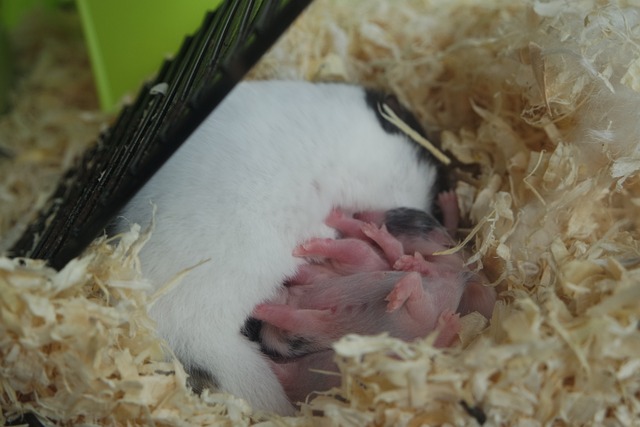
Before breeding hamsters, one should consider why s/he should breed his/her hamster.
A better optin would be to adopt a hamster. Reason being is that there are many unwanted hamsters who end up without a home.
If on the other hand you still want to breed your hamster or if your hamster had an unexpected pregnancy, then the following information will help you in trying to make the reproduction process work better for the hamster.
A female Syrian Hamster can breed from as young as 4 weeks of age, but it is best to breed for the first time at around 4 to 6 months of age.
Dwarf Hamsters will breed at around 3 to 4 months of age, while the Roborovski Hamsters usually do not breed until they are 8 months old.
Once bred, the female hamster should be given 4 months to recover condition before breeding again. Female hamsters are usually sterile at 12 to 14 months of age.
A female hamster will be in heat every 4 days which means that a female hamster will accept a male hamster for mating on the fourth day of each cycle. Click here to read more about the female hamster's cycle including the female hamster lordosis position. To understand what is hamster lordosis, click here.
A female Syrian Hamster should only be introduced to a male hamster in a neutral territory. This means that hamster mating should never take place in her cage or in his cage, but in a neutral territory like for example in a new cage or an enclosed area of your room. This also applies for Chinese Hamsters. If the female hamster attacks the male hamster, it means that the female is not in heat. When a female hamster is in oestrus, she will accept the male hamster and mate. On the contrary, Dwarf Hamsters are much easier to mate. When housing a female and a male Dwarf Hamster in the same cage, the female will soon become pregnant. If you notice some blood at the female's rear area, it can mean that she did her first mating.
Regarding Syrian and Chinese Hamsters, it is very important to separate the male hamster after mating since they are solitary animals. In the case of Dwarf Hamsters, it is best to separate the male hamster when the female gives birth since the female hamster will be immediately in heat after giving birth; the male hamster will mate the female again and it is not healthy for her to have two consecutive pregnancies. Also, in the case of Dwarf Hamsters; if two or more female Dwarfs are housed together and one of the female hamsters is pregnant, you can leave the female Dwarfs housed in the same cage with the pregnant hamster since, they will help the mother hamster taking care of her babies!
When the female hamster is pregnant, she will start to build a nest and during the last two days, she will gain weight in her stomach area which will become very noticeable. Some female pregnant hamsters may become more aggressive as their delivery due date approaches.
The gestation period for Syrian Hamsters is 16 days, Dwarf Winter White Russian Hamsters, Campbell’s and Chinese Hamsters 18 to 21 days while for Roborovski Hamsters 23 to 30 days.
When the female hamster gives birth, it is very important not to touch the nest or babies and avoid cleaning the cage for the first three weeks or else the mother hamster may panic and kill the hamster babies. If it is really necessary to 'clean' a cage area while the mother hamster is nursing her babies, you should only use a small piece of tissue to 'clean' the cage but avoid touching the nest area. Apart from the normal hamster food mix, put some bread soaked in milk (skimmed cow milk is fine) in a small food bowl as this will provide extra proteins to the mother and baby hamsters. Replace the bread and milk at least 3 times daily until the pups are 4 weeks old. The cage should be placed in a quiet room, since noises can cause the mother hamster stress.
In the case of Syrian Hamsters, the babies must be separated from the mother hamster when they reach 4 weeks of age. Separation must take place at 4 weeks of age since the hamsters would be sexually mature. In the case of Dwarf Hamsters, you can keep the female baby hamsters with the mother and separate the male baby hamsters and keep them in another cage to avoid mating. Never introduce the male baby hamsters to the father since he will not accept them and the babies will be afraid. In the case of Syrian and Chinese Hamsters, it is best to house the babies one per cage since they are solitary.
What do you do if your hamster gives birth and then dies? Click here to read more.
KNOWING THE SEX OF A HAMSTER
It is very tricky to determine the sex of a hamster. In Syrian Hamsters, it is more easy to know their sex than Dwarf Hamsters due to their size. A male hamster will have testicles and by time these will become more noticeable. The easiest way to know the gender of your hamster, is to look at the distance between the two openings at the rear.
If the hamster is still not tamed and is afraid of you then, you can use the 'transparent box / bowl' technique. Put the hamster in the transparent box / bowl and have a peek from under the box / bowl. Alternitavely you can pick the hamster by the scruff and look at that area. Handing hamsters by the scruff has to be done very rarely since too much handling from the scruff can lead to hamster glaucoma. The above procedures can be used for Syrian, Dwarf Campbell, Dwarf Winter White and Chinese Hamsters.
In the case of Roborovski Hamsters, it is best to look at its rear area by scooping the hamster softly but firmly and holding it gently, to check the distance between the two openings at the rear. Another alternative for knowing the sex of Roborovski Hamsters is by using the 'transparent box / bowl technique as described above.
In male hamsters, the anus and the penis (which is kept tucked up inside a small opening) are further apart. Mature male hamsters possess large, prominent testicles just under their tails.
In females the anus and the vaginal opening are much closer together in comparison to the male hamster. Female hamsters will have nipples and if the coat is short these can be noticed. The picture on the right shows a female hamster.
A small tip on how you can identify the sex of your hamster is, that a male hamster will have a very small 'pink dot', while a female hamster does not.
Click here to read a hamster article about male hamsters.
photo credit





 by Albert Saliba