HAMSTER HEALTH
Firstly, make sure that you have a hamster first aid kit available at all times. Click here to check out the hamster first aid kit.
Also make sure you know that some antibiotics are harmful to hamsters. Click here to view a complete list of harmful hamster antibiotics.
Below, you may find some of the illnesses hamsters may develop:
Hamster Colds
Hamster colds can be caused from draughts so placing the cage in the right place is very important. The symptoms of hamster colds are: hamster sneezing, hamster wheezing, hamster with wet nose, hamster breathing heavily and the hamster always sitting in a hunched position.
It is very important that you never wash you hamster. One of the common reasons why a hamster catches a cold is from baths. Never handle a hamster when you have a cold as the hamster will easily get a cold from you. A hamster with a cold should be kept in a draught free and warm room. Palatable foods (soft food) are good for sick hamsters. Instead of water, put lukewarm milk in the hamster's drinking bottle. The lukewarm milk should be changed at least three times daily for two days.
 Hamster Wet Tail
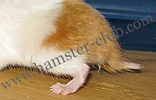
Hamster wet tail is a bacterial infection and can cause extreme diarrhoea. Stress and an unbalanced diet can be two major causes of wet tail in hamsters. An example of stress for a hamster can be a trip from the pet store to home. Wet tail is a disease associated more commonly with the syrian hamster. The area around the hamster's anus becomes sticky and wet-looking when the hamster has wet tail. The sick hamster will move very slowly, will be very quiet and will not eat. When a hamster has wet tail, take it to a vet immediately.
Isotonic fluids may be administered orally to the sick hamster and the vet may also prescribe antibiotics for the hamster. Metronidazole POM is useful in treating digestive upsets and wet tail. Dose is 20-60mg/kg twice daily. ‘DriTail’ may also be used for the hamster. You can put ‘DriTail’ in the water bottle to help the hamster recover quickly. Forced feeding with liquidised vegetables and hamster food may be used if the hamster refuses to eat. Adding sweeteners such as honey to the hamster's food may encourage an increased appetite in a recovering hamster. Hamsters should be kept in a warm and quiet environment to reduce stress. Any cages of dead hamsters should be binned or washed well and disinfected.
Hamster with Reddish Urine
Reddish urine can be caused from a type of hamster mix or from a type of pellet hamster food. Thus if you notice that your hamster has reddish urine, first try to check whether the source is from the hamster food. We had cases where the hamster food had red coloured processed stuff and these led to some hamsters producing reddish urine. Changing the hamster’s food to another brand may help.
Other reasons why a hamster might have reddish urine may be from bladder stones, uterine infection or pyometra. It is advisable to change the type of food before concluding that the hamster has bladder stones, a uterine infection or pyometra.
 Hamster Bladder Stones
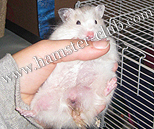
The symptoms that a hamster may have bladder stones are tiny drops of bloody urine which may leak from the hamster. The hamster will be in pain especially when urinating and the hamster will begin to look unwell. Offering dandelion leaves may encourage increased urine production so that the bladder stones come out. Dandelion leaves may be picked from fields or obtained from a gardener. Try to avoid picking leaves that are close to roads.
An alternative is adding low levels of table salt to the water or food. Addition of a little fruit juice to salted water may improve palatability to increase consumption. You can also give some vegetables and some soaked food to your hamster. Giving the hamster extra vitamin C, will also help in reducing the hamster's bladder stones.
 Hamster Penile Plug
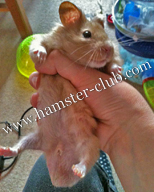
When a male hamster finds it difficult to urinate, most of the times this is due to excess hamster penile plug. The hamster penile plug is usually whitish/yellowish but if the blockage is not this colour, then that is due to an infection. If hamster penile plug is left unattended, this will cause the hamster penile opening to become blocked.
A hamster with penile plug may still be active, that is why it is important to constantly check the male sexual organ and make sure that he is peeing daily. If left unattended, the hamster will find it difficult to try and urinate and will die.
How to know if your hamster has penile plug:
We suggest that you daily check out the hamser penile area to make sure that it looks ‘normal’ and that it is not blocked. If you are using shavings, you may find it more difficult to determine if the hamster is urinating or not. If your hamster has a potty area, then it is easier for you to know if the hamster is peeing normally. A hamster with penile plug will find it difficult to pee. You may notice the hamster trying to take the position to pee and not being able to. The hamster may also squeak from pain to try and relief himself.
 How to remove hamster penile plug:
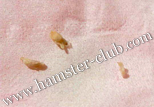
The picture on the right shows the removed hamster penil plug. To excrete the blocking content, gently squeeze the penile opening from both sides. If you do not succeed in removing the penil plug, then apply some olive oil around the hamster uterine opening and put the hamster back in the cage.
The olive oil will lubricate the area and this will make it easier for the hamster to clean himself.
You may also ask a vet to remove the plug from the hamster's penile opening. The vet will usually perform such procedure using tweezers.
 Hamster Pyometra
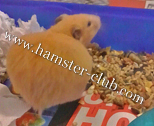
Hamster pyometra is an infection of the uterus and the womb becomes infected. If you find some blood in the hamster's cage, you must not mistake pyometra with first breeding...meaning that if the hamster was recently bred for the first time, then there will be a small amount of blood (which is normal).
Pyometra affects only female hamsters. The first symptoms are bloody discharge, then eventually after a few months, the abdomen becomes swollen and enlarges in size.
Usually this infection is life threatening if action is not taken immediately. The only option in many cases is surgical removal of the uterus. This will remove the infection and prevent uterine rupture, and of course a recurrence of the disease.
 Hamster Amyloidosis
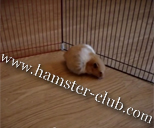
Hamster amyloidosis is a condition which affects some old hamsters. This condition produces sheets of dense proteins called amyloid. Since the amyloid gets deposited throughout the hamster's body, it prevents the hamster's organs (like heart, liver and kidneys) from working normally. Once this happens, fluid accumulates in the hamster's abdomen.
The main symptoms of hamster amyloidosis are: hamster with an enlarged stomach (make sure that you do not confuse this with hamster constipation. In the case of hamster amyloidosis, the hamster's stomach is much more enlarged), the hamster's faeces may appear smaller in size and/or the hamster's rectum may be seen a bit prolapsed. If a small portion of the hamster's rectum is prolapsed, whilst making sure that your hands are clean, gently place one finger on each side of the rear and squeeze gently (from the side) to push back inside the prolapsed rectum. A visit to the vet is recommended.
Short-term care may include giving your hamster diuretics (like dandelion leaves) to help move fluid out of the hamster's stomach. Giving your hamster diuretics is not always effective, especially if the hamster's kidneys are failing. Unfortunately there is no cure for hamster amyloidosis. Just make sure to provide your hamster with a stress free environment and let your hamster rest.
 Hamster Diarrhoea
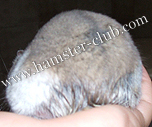
Hamster diarrhoea is a result of incorrect feeding and sometimes in combination with draughts or damp. Rotten food or dirty drinking water and overfeeding of fruits and vegetables can also be a cause. The symptoms of hamster diarrhoea are: green faeces, soft faeces and unusual large amounts of faeces.
If your hamster has diarrhoea, remove any moist food out of the cage and feed your hamster only dry bread, boiled rice and crisp bread. Replace its water with lukewarm chamomile tea three times a day, for two consecutive days. When your hamster gets better, disinfect its cage well.
Hamster Constipation
Hamster constipation takes place when the hamster has a blocked bowel. This can be the result of an ingestion of bedding or when the hamster is not taking enough fluids. The hamster shows signs of abdominal discomfort and stops eating.
Try adding fruit and vegetables (like lettuce or dandelion leaves) to the hamster’s food or orally give the hamster one drop of vegetable oil (like for example olive oil). Repeat this process for two days. Make sure that the hamster always has access to fresh clean water.
 Hamster Rectal Prolapse / Hamster Prolapsed Rectum
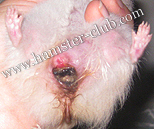
A hamster rectal prolapse / hamster prolapsed rectum is a condition where the hamster's portion of its rectum will be seen coming out from the hamster's anus. This problem can be solved by a good vet that treats small mammals.
The vet will replace the prolapsed section of the bowel under general anesthesia and then he will apply a purse-string suture to the anus to prevent re-occurrence of the prolapsed rectum. Another option is to remove the prolapsed section of the hamster if it has been badly damaged. 'Ruta' and 'AEsculus' can help in the replacement of such lesions.
Hamster Diabetes
Hamster diabetes is commonly found in dwarf hamsters especially in campbell's hamsters. Diabetes is often hereditary. Some of the symptoms of a hamster with diabetes are: hamster drinking excessively, hamster losing fur on the stomach area and on the hands, excessive urinating, the hamster all of a sudden sleeping more than usual, hamster doing excessive exercise, hamster with a sudden weight loss / gain and the hamster trembling.
Feeding a sugar free diet will help the hamster. Commercially processed food treats and fresh fruit should be avoided because they may contain fructose. You should incorporate more protein into a diabetic hamster’s diet. A pedialyte solution in the hamster's water bottle, will help the hamster not to dehydrate.
Hamster Strokes
Hamster strokes often happen during the night, so the first sign is when the following morning the hamster is unbalanced and typically the head tilts to one side. Head tilt may also take place when the hamster has an internal ear infection, sometimes secondary to a respiratory infection. Bacteria are the usual cause and treatment is with antibiotics prescribed by a vet.
Usually hamster strokes happen due to old age. Another reason why a hamster suffers a stroke could be from excessive heat. It's important that the hamster's cage is in a room at a temperature between 65°F / 18°C and 80°F / 26°C.
Another symptom of a stroke may be when the hamster runs in circles. In the case of male hamsters, another indication of a stroke is when the hamster acts normally and then all of a sudden, enters in a sort of a ‘trance,’ where it stops staring almost as if it is hypnotised. Make sure that you do not misinterpret this with hamster lordosis which only happens to females and is very normal. Click here to read abour hamster lordosis.
The hamster may need help with feeding and drinking. Giving your hamster an easy and healthy life will help it live its life as normal as possible. You must house the hamster in a one level cage and remove any objects or toys that might hinder the hamster's way and make the hamster fall.
Hamsters who have suffered a stroke may live quite a while longer and lead fairly normal lives, although some head tilt may remain. Patience is an important factor.
 Hamster Clonic Seizures
In rare cases hamsters may suffer from clonic seizures. Usually this type of illness is hereditary and such hamsters should not be bred.
Symptoms of seizures are: the hamster’s arms and legs will jerk, the hamster will move uncontrollably, its mouth may be open and it will find it difficult to close it, the hamster’s tongue may be seen outside its mouth and the hamster may have a watery mouth for a few seconds / minutes. Also, the hamster’s gaze will look dull and during seizures the hamster may have some diarrhoea and/or may pee on itself.
What to do if your hamster has a seizure.
If you suddenly see your hamster having a seizure DO NOT PANIC. If you panic, the hamster will sense your panic, it will panic more and the outcome of the seizure will do more harm to the poor hamster. Speak to the hamster in a soft voice and place your hand around the hamster (in the cage). The outcome of this would lead to the hamster not panicing and being more relaxed, thus such seizure will be shorter.
When the seizure stops, let the hamster rest. When the hamster is back to normal, you will have to house the hamster in a one level cage and remove any ramps or ladders from the hamster's cage to prevent injuries.
Hamster seizures may look shocking to the human eye, but only our constant love and support to the hamster will help it live a normal and happy life.
Hamster Back Flip / Hamster Running in Circles
When a hamster constantly does back flips or runs in circles, these symptoms are usually due to neurological disorders. Most of these disorders are often genetic.
When one has a hamster that does back flips or constantly runs in circles, s/he must house the hamster in a one level cage and remove any toys that may cause the hamster injury. If the case is extreme and the quality of your hamster’s life is not what is should be, then hamster euthanisation may be considered.
Hamster Skin Mites
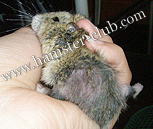 A skin mite is a harmful parasite. A skin mite is a small spider-like creature that goes into the hamster’s skin making the mite itself almost invisible!
If a skin mite affects a hamster which is in a colony, then the whole colony is affected. Skin mites can be passed on to other animals. Due to excessive scratching the hamster can lose some fur.
Applying an anti-mite spray intended for hamsters should treat skin mites. Disinfect the whole cage and apply some anti-mite spray.
Do not apply the spray directly on the hamster but apply two to three puffs on a small brush - you can use a clean toothbrush, comb the brush on the hamster and then use a small cloth or tissue paper to dry off the hamster. Apply two to three puffs on the hamster's clean bedding. Follow the instructions written on the anti-mite spray.
 Hamster Mange
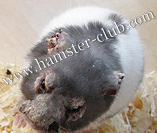
The picture on the right shows a hamster with mange near the ears and face, but the following information also applies to all hamster mange in general.
Hamster mange / mites are also are known as Notoedres. These hamster ear mites shown in the picture, multiply around the infected hamster’s ears and the hamster becomes allergic to these mites and starts itching itself. The hamster’s skin becomes crusty, darkened and the hamster may also develop deep injuries around the head region due to self-mutilation. The first step is to disinfect the cage and replace the bedding to paper based bedding like tissue paper and toilet paper.
Treatment of hamster mites / hamster mange consists of either Ivermectin injections by the veterinarian or Ivermectin can be administered orally. Ivermectin is administered weekly over several weeks. Creams may be required to rapidly reduce initial itching. The hamster’s cage needs to be cleaned at the time of each weekly treatment to avoid re-contamination of the mites. Diluted oils can be used cautiously like olive oil, for direct application. Lavender, rosemary, tea tree and garlic oils may also be useful.
 Hamster Cancers / Tumours
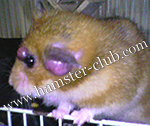
The hamster develops a lump which gets bigger by time and early referral to a vet is vital to increase the chance of successful treatment. The risk of cancer rises when the hamster ages.
Hamster cancers and tumours are often treatable. Sometimes when hamster tumours are removed, these can grow up again. Vet's operations on hamsters are not always successful due to their small size and some antibiotics may also be harmful to the hamster. Unfortunately one of the causes of hamster tumours is in-breeding ie: breeding hamsters of the same family example: a brother and sister.
A hamster with a tumour may live a normal and happy life but try to avoid any sharp objects (like wooden ladders, wooden ramps or
tubes)
as these can cause the tumour to burst. If the tumour
bursts, apply saline water to the wound.
 Hamster Cysts
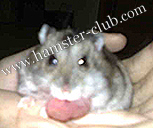
A cyst is a fluid-filled cavity or sac. Sometimes it contains air or semisolid material. The hamster photo on the right shows a hamster with a cyst in the buccal cavity (that is in the mouth area). The cysts can become quite large and it will result in the hamster having a big and swollen area. By time the cyst will get bigger and the hamster will have problems in eating properly.
A hamster cyst can be treated by a vet who drains the hamster’s cyst; even though cysts may reappear later. If the cyst bursts, you can apply the same procedure as to when a tumour bursts (read Hamster Cancers / Tumours section above).
Hamster Protein Deficiency - Loss of Nails
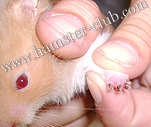 A hamster may have some side effects due to lack of proteins in its diet. Some of these side effects are: weak nails, loss of nails, loss of fur, pneumonia, infertility and poor growth especially in young hamsters.
The picture on the right shows a hamster with protein deficiency which lead to poor nails and the nails may fall off.
So feeding your hamster a good and healthy diet with proteins is very important. Proteins may be found in peas, beans, soya and cheese.
Hamster Overgrown Nails
Never clip short hamster nails. Only clip your hamster's nails if they start to fold or curl sideways. A natural way of keeping your hamster's nails naturally trimmed, is by putting a small rock in the cage. Usually the hamster will walk on the rock and file its nails down.
On the other hand, you can also purchase small animal, kitten or puppy nail clippers from good suppliers on eBay, pet shops or from some veterinary surgeries. These special clippers are small enough to clip the nails on a hamster and have a notch at the end of each blade to hold the nail and give a clean finish.
How to clip your hamster's nails:
Hold your hamster and be careful not to squeeze too hard. Keep your pet calm and don't begin to clip your hamster's overgrown nails before the hamster is calm. Stand in bright light. Sunlight works especially well. Nails are translucent and easier to clip in bright light, where you can easily spot the blood supply or quick.
Gently squeeze a toe to separate and extend the nail. Look for a dark interior area. This is the quick and you must not cut through it. Place the clipper just beyond the start of the quick and clip the animal's nails one by one.
If you accidentally nick the quick, the nail will bleed. Gently apply some styptic powder like 'Kwik Stop' to the nail; this will stop the flow of blood and thus the nail will stop bleeding.
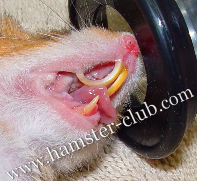 Hamster Overgrown Teeth
Hamsters' teeth are approximately 15mm long - sometimes shorter. Hamsters' teeth are always growing and small pet chew toys or apple wood and dog biscuits should be given to hamsters to keep the hamster’s teeth under control.
Many hamsters will gnaw on the bars of the cage, but if a hamster has nothing to gnaw on to keep its teeth in trim, the hamster’s teeth may overgrow and can puncture the mouth or jaw, which would lead to the hamster not being able to eat properly and the hamster starves to death.
If your hamster's teeth become overgrown the vet may trim them for you and the s/he may also show you how to trim the hamster’s teeth if they overgrow again.
How to Clip your Hamster's Overgrown Teeth
The hamster’s teeth can be clipped using a pair of nail clippers but care must be taken to avoid cutting the hamster’s tongue or cheek. When you trim the hamster's teeth, you have to stay calm since the hamster would sense your tension and become agitated.
To clip your hamster's teeth, hold the hamster by a good scruff of neck forcing the hamster to 'smile' and ensuring that the hamster remains still. Place the nail clippers around the tooth to be cut, ensuring that the blade behind the tooth is pressed firmly and trim the hamster’s teeth.
Why Hamsters' Teeth May Break
Hamsters' teeth may break more easily if the diet is low in calcium and dog biscuits are a good source of calcium. Giving the hamster only sunflower seeds in its diet, will not provide it with the correct amount of calcium. Therefore, feeding your hamster a good diet including a good hamster food mix is very important.
What happens when a hamster breaks one or more of its teeth?
When this happens, the opposite tooth becomes overgrown. This will cause complications if left unattended. The same happens if a tooth becomes crooked. A hamster may break its teeth or the teeth may also become crooked especially if a hamster is very old.
If the hamster’s teeth break, this can cause the hamster to stop eating since the hamster would find it difficult to eat. In such cases, one should feed the hamster soft food like bread soaked in milk, scrambled eggs or hamster mix which may be softened with water.
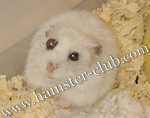 Hamster Glaucoma
One of the illnesses hamsters may have is glaucoma. Glaucoma affects the eyes of the hamster and its symptoms are that the hamster's eye will appear larger. When glaucoma takes place, there is an increased amount of fluid within the eyeball which will lead to loss of vision. The affected hamster will rub the eye and the eye may become so big that it prolapses from the socket.
Hamster glaucoma can be a result of rough handling, fighting or from being held too tightly from the scruff. To decrease the chance of hamster glaucoma, avoid holding the hamster from the scruff. Hamsters naturally have big eyeballs to be able to spot predators and glaucoma should not be misinterpreted by this.
Unfortunately there is no specific treatment for hamster glaucoma and early referral to a vet is important as the vet can prescribe painkillers if the hamster is in a lot of pain. As earlier outlined, glaucoma may lead to loss of the hamster's vision, but this is not a big problem as a hamster's eyesight is very poor. Affected hamsters should not be used for breeding. An eye ointment prescribed by a good vet may be used several times daily to keep the hamster's eye moist.
Hamster Sticky Eyes / Hamster Conjunctivitis
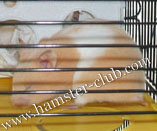 The reason for a hamster having sticky eyes is that the hamster may have conjunctivitis. Conjunctivitis is an inflammation of the insides of the eyelids that cause the eyes to stick together. In most cases the hamster's eyes will look red. The causes of hamster conjunctivitis / hamster sticky eyes can be from allergic reactions to bedding, or tiny pieces of irritants getting under the eyelids such as bits of sawdust. A hamster with conjunctivitis will rub the eyes and look unwell.
The hamster's eye must be cleaned using a clean cotton wool and appling some cooled boiled water to the cotton wool. Then dab the wet cotton wool, to the hamster's closed eye once a day. Repeat this until the hamster's eye is back to normal.
Also, try using a different brand of wood chippings or stop using chippings and instead cover the hamster's cage floor with paper based bedding. Do not use air fresheners, carpet shampoos and avoid cigarette smoke. These only harm the hamster in making it fell unwell.
Applying euphrasia lotion to the eye, diluting one drop in an egg-cup full of boiled cooled water (which may be given to the hamster via drinking water) and Pulsatilla are some homeopathic remedies which may help the hamster feel better if it has sticky eyes.
Hamster Cataracts
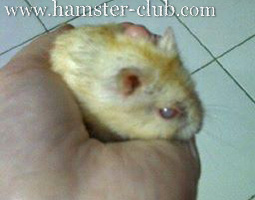 Hamster Cataracts is when the transparent lens within the hamster's eye becomes cloudy and white. This may just only be a feature of ageing or when the hamster has diabetes.
The vision for the hamster will become distorted more as the cataract gets whiter. However since the hamster's vision is naturally very poor, this may be of little significance. Theoretically speaking, the hamster's faulty lens can be removed from the eye but the technical difficulties and the debatable benefits of surgery for a species where eyesight is naturally poor makes this an unlikely choice of treatment.
If your hamster has cataracts, then use a single level cage to reduce fall accidents. Greater care must be taken when you approach the hamster so that the hamster does not get started. However since the hamster's vision is generally so poor and their nocturnal nature means they rely more on other sense, there is often little change seen in hamster's behaviour.
 Hamster Obesity
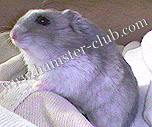
Hamster obesity takes place when the hamster is overweight due to an incorrect diet, thus, the hamster’s health is affected. The approximate weight of a Syrian Hamster is from 140 to 200 grams, the weight of a Campbell's Hamster is from 30 to 50 grams, Winter White Russian Hamster from 21 to 26 grams, Roborovski Hamster from 20 to 25 grams and a Chinese Hamster from 30 to 45 grams.
An overweight hamster will appear enlarged and the hamster will also become lazy due to the effort needed for moving.
The solution for hamster obesity is to replace any sugary treats with vegetables. Increase exercise (like for example more usage of the hamster ball for the hamster to exercise) so that the animal will lose weight and will get fitter. You can also introduce more play outside the cage; for example hamster running in the room, but make sure that you always keep an eye on the hamster while it is running in the room.
Hamster Respiratory Problems
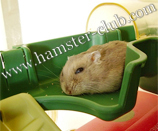 When a hamster is in a stretched out position like the picture on the right, it shows a sign of distress and in this case, the distress is derived from respiratory problems.
Symptoms of a hamster with respiratory problems may include: puffed lungs, slow breathing and the hamster squeaking when breathing out. Also, an affected hamster will show exhaustion and will eventually collapse even after very mild exercise. The exercise should also be reduced and you may also move the hamster in a single level cage and remove the hamster's wheel. One should also remove any dusty bedding and instead use paper based bedding like tissue paper or toilet paper.
When there is a secondary infection, use of antibiotics (prescribed by a good vet that treats hamsters) may be helpful. One may use 'Carbo veg.' or 'Arsenicum album' as homeopathic remedies, always under expert homeopathic veterinary guidance.
Hamster Paralysis
A hamster may become paralysed after an accident like falling from a considerable height. You should leave your hamster to recover itself in its cage and in a non-stressful environment.
If the hamster refuses to eat after a few days, you need to hand feed it soft food which may include baby food. Usually as time goes by, a paralysed hamster deteriorates and recovers only in rare cases.
Thus the best way for hamster paralyses is prevention. The hamster’s cage has to be as safe as possible – the cage should have no pointed objects and if it has a ladder, it should be stable. The ladder should be made of plastic and not of wire.
Any out of the cage play has to be monitored even in your room. Never let your hamster go on high levels of furniture since it can jump and one of the common reasons for hamster paralyses is derived from this.
 Hamster Greasy Fur
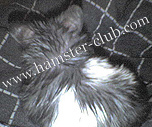
A hamster with greasy fur, can be a sign that the hamster's bedding is not being changed frequently. The hamster's bedding should be supplied generously to prevent odours. The hamster's bedding should be changed at least once a week. For nesting materials you should be using a paper based material such as toilet paper or shredded paper.
An old hamster may also have some greasy fur, especially in the case of Roborovski hamsters. Also, a hamster with greasy fur, can also be a sign of illness;
the hamster is too lethargic to clean its fur. If your hamster is lethargic, you should
take it to the vet, since lethargy is a sign of a number of illnesses. Also sometimes
greasy hair can be from the hamster's genes ie: the hamster's coat type is genetically greasy. If you put some oil to the hamster wheel to make it less squeaky, the hamster may have touched the oil and the fur may appear greasy, so make sure that you check the wheel before concluding that the hamster is sick!
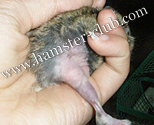 Hamster Fur Problems
The most common signs of hamster fur problems are: loss of fur, sores, dry, itchy skin, reddened skin. These problems may be caused by tiny skin parasites, allergies, hormonal imbalance or improper diet. Mother hamsters shed fur around their teats when they are nursing their young baby hamsters. Old hamsters have less fur due to a drop in certain hormone levels as the hamster gets older.
Hamster having an allergy can be one of the most common reasons for hamster fur loss. Cedar Shavings can cause allergic reactions. Pine shavings are preferable to cedar but paper based shavings are the best. The most common reason for hamster fur loss is due to the hamster's bedding, thus if you are using wood shavings, we really recommend that you disinfect the whole cage and cage furnishings and replace the wood shavings to torn toilet paper.
A hamster may become allergic to certain foods. Feeding the hamster a plain diet for a few days may establish if the hamster is suffering from a food allergy. When you establish what is the source of allergy that is making the hamster losing fur, then remove the source immediately.
 Hamster Skin Problems
The picture on the right shows a hamster with a skin reaction on its paws.
The cause of the skin reaction can be from the bedding or from a change in the food and / or lifestyle of the hamster.
If the bedding is the cause of the hamster’s skin reaction, change the hamster’s bedding to tissue / toilet paper and see whether it will help at all.
If you see that there is no improvement, then monitor the hamster’s diet; see whether there were any changes in the hamster’s diet which could have caused the skin reaction to the hamster.
Keep in mind that a skin reaction may also be caused from high temperatures. The right room temperature for a hamster should be 65°F / 18°C and 80°F / 26°C.
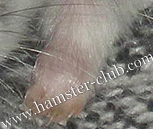 The hamster's feet may become swollen if you are using a wire cage, with a base made of wire. A wire floor can be made easier on the hamster's feet by covering it completely with Magic Mat.
You can also use plastic needlepoint canvas - which is found in craft stores.
These coverings can be cut to fit and attached to the floor or sides of the hamster's cage with twist ties. You can also pile on soft nesting material for added comfort.
A hamster with a skin reaction should be treated immediately.
Monitoring any changes in the hamster’s lifestyle can determine the cause of the hamster’s skin reaction.
Hamster Ringworm
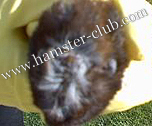 Hamster ringworm is a type of fungus that grows on the hamster's skin, hairs and nails. As the fungus grows, hairs are broken which then leads to bald areas of the skin – picture on the right shows a hamster with ringworm that affected the hamster's head area.
Hamster ringworm may grow when using plastic enclosed cages since the fungus prefers high humidity and these cages do not provide good ventilation.
Always wear gloves when handling a hamster with ringworm. Medication with griseofulvin for at least 4 weeks may be combined with shampooing with povidoneiodine, or antifungals such as eniconazole or natamycin. The hamster’s cage should be cleaned frequently. The cage should be disinfected with a very good disinfectant and should have good ventilation.
Hamster Cuts / Bruises
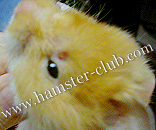 There are times when a hamster cuts itself because of an accident and in order for the cut to heal itself, one can apply tea tree cream on it. Tea tree cream can be bought from the pet pharmacy.
An alternative is using tea tree cream (for humans) which can be bought from a pharmacy.
If you keep more than 1 hamster, in the same cage, it is a good idea to put a small dab of cream on the other hamsters to prevent them from turning against the one being treated.
Tea tree cream is an excellent antiseptic for putting on cuts and scratches and can help the hamster heal itself quicker.
Hamster Broken Leg / Fractures
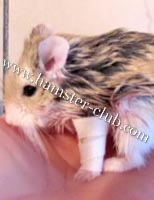 If you suspect that your hamster has a fracture, like for example if your hamster broke its leg or you see your hamster dragging its leg, then you must take your hamster to the vet immediately.
While you do this (or if the vet is not available), make sure that your hamster's cage is safe.
For example, if the hamster's cage has multiple levels, you must remove the multiple levels and ramps so that the hamster will have a one level cage.
This way, the hamster will not fall and damage the fractured area more.
Also make sure that you remove the hamster's wheel until your hamster gets better.
Never touch the hamster's broken leg/area, this will only make matters worse.
Only a vet will assess the extent of the broken area and s/he may presribe you some hamster antibiotics to give to your hamster to help ease the pain.
Hamster Abscesses
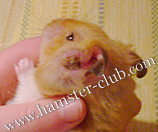 A hamster has an abscess as a result of a bacterial infection which gains entry into the hamster's body from a wound. Reasons why the wound may have formed itself are: from a hamster fight and if the hamster fell from the cage.
One of the symptoms of an abscess is a swelling which may enlarge by time and rupture to release smelly thick creamy pus.
A hamster's abscess may be drained by a vet that treats hamsters.
After the abscess is left to drain, it should be then be cleaned twice daily with a good antiseptic such as Tamodine (Vetark Professional).
Care must be taken after to make sure that re-occurence does not take place.
Hamster Moles
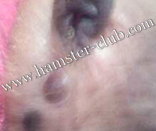 The most common reason for a hamster developing a mole or two is due to old age.
When a hamster is older than 1 year, it's natural that some changes in the hamster's body take place and thus a mole may appear.
A hamster mole is nothing to be alarmed of, it's normal and it's mostly due to old age.
A hamster with a mole may live a normal hamster life with a normal diet and normal hamster routine.
Hamster Hibernation
Hamsters are most comfortable at temperatures between 65°F / 18°C and 80°F / 26°C. Sudden temperature drops may lead to hibernation. A hibernating hamster look dead, but if you look closely, you will see its whiskers move slowly from breathing. To prevent hamster hibernation, make sure that the hamster’s cage is out of draughts.
If your hamster goes into hibernation you have to get it warm. Place the hamster on a reptile heating pad which can be placed under the tank. These are safe and self-regulating. You can also put the hamster on a covered water bottle (which you should place in the cage so that the hamster won’t escape if it recovers) at around 86°F / 30°C for a few hours.
Rub the hamster softly, but with friction. This will help the hamster to wake up. You will have to bottle feed the hamster with some water and sugar. The amounts should be: one teaspoon of sugar to one cup of water. After some time, the hamster will start to shiver but this is very normal and it means that the hamster is feeling better. When the hamster wakes up, you may give it some soft food or baby food for approximately three days. You can give the hamster some Carb-v (Carbo Vegetabilis), which is a vegetable charcoal prepared from selected birch or beech wood.




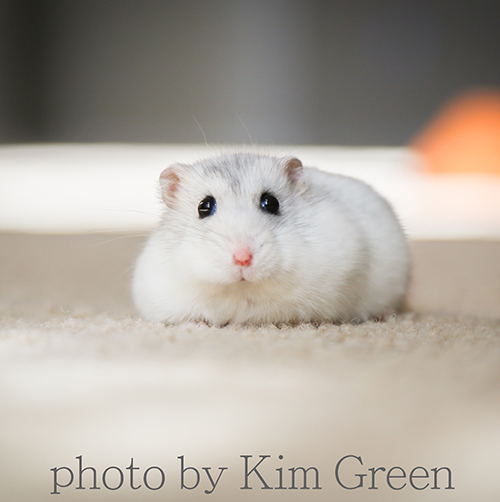
 by Albert Saliba